Florida Vibration Monitoring & Pile Driving Compliance Services

Seismic Surveys provides vibration monitoring in Florida for pile driving, bridge, roadway, and marine construction projects, with offices in West Palm Beach and the Orlando metro. Our monitoring programs measure the vibration your work sends into adjacent structures, document it against FDOT and project limits, and give your team the records it needs if a neighbor files a claim.

From seawall replacements in Miami Beach to bridge work for FDOT, our engineers and geologists set up construction vibration monitoring that matches the contract documents, the soil, and the structures around your site.
Why Vibration Monitoring Matters on Florida Construction Projects

Florida’s growth puts heavy construction right next to homes, high-rises, historic buildings, and waterfront structures. Common projects that call for monitoring include:

  • Bridge replacement and widening
  • Highway and interstate construction
  • Seawalls, docks, and marina replacements
  • Beach renourishment and shoreline protection
  • High-rise and commercial building foundations
  • Utility, drainage, and water infrastructure

Vibration that stays within safe limits can still lead to complaints and unwarranted damage claims. Collecting vibration data at neighboring properties before and during construction is a contractor’s best protection. Soil matters too: research presented to Florida contractors notes that poorly graded, uniform sands are the soils most prone to vibration-induced settlement, in some cases at ground vibration as low as 0.10 in/s.

FDOT Vibration Monitoring Requirements Under Section 108

On FDOT projects, monitoring of existing structures falls under Section 108 of the Standard Specifications for Road and Bridge Construction, Monitor Existing Structures. Vibration monitoring applies when the contract documents call for it, usually in the Summary of Monitor Existing Structures table in the roadway plans.

What Section 108 Requires

  • Qualified Specialty Engineer: vibration monitoring and pre- and post-construction surveys are performed by a qualified Specialty Engineer.
  • Continuous monitoring: vibration is monitored at the structures shown in the plans while vibration-causing equipment is running or during blasting.
  • Reporting within 24 hours: vibration records go to the Engineer within 24 hours of the monitoring activity.
  • Sensitive instruments: equipment must detect velocities of 0.01 in/s or less.

What Section 108 Requires

Before work that may affect nearby structures begins, Section 108 requires a documented survey of existing conditions, including descriptions and photos of existing cracks. A second survey follows construction to identify any changes and whether construction caused them. Our pre- and post-condition surveys produce exactly this kind of record.

Pile Driving Vibration Limits and Compliance Thresholds

Pile driving is one of the most common sources of construction vibration on Florida jobs, and it is where Section 108 sets its clearest rules.

  • Action threshold of 0.5 in/s: when vibration reaches 0.5 in/s or any structural damage is observed, the contractor stops the vibration source, backfills open excavations, notifies the Engineer, and submits a corrective action plan.
  • Survey distance: structures within 0.25 times the square root of the hammer energy (in ft-lb) are inspected and documented before and after driving.
  • Settlement monitoring distance: structures within 0.5 times the square root of the hammer energy are monitored for settlement. For a 40,000 ft-lb hammer, that works out to about 50 feet for surveys and 100 feet for settlement monitoring.
  • Sheet and soldier piles: structures within 200 feet of sheet pile installation or extraction and within 100 feet of soldier piles fall inside the monitoring zone.
  • Daily settlement readings: settlement is checked daily while piles, casings, or sheeting are driven, then weekly for two weeks after driving stops.

Project specifications, local permits, or a vibration-sensitive structure next door may set tighter limits than FDOT’s. Pile driving vibration monitoring with automated alerts lets your crew adjust before a reading becomes an exceedance.

Coastal and Marine Construction Monitoring in Florida

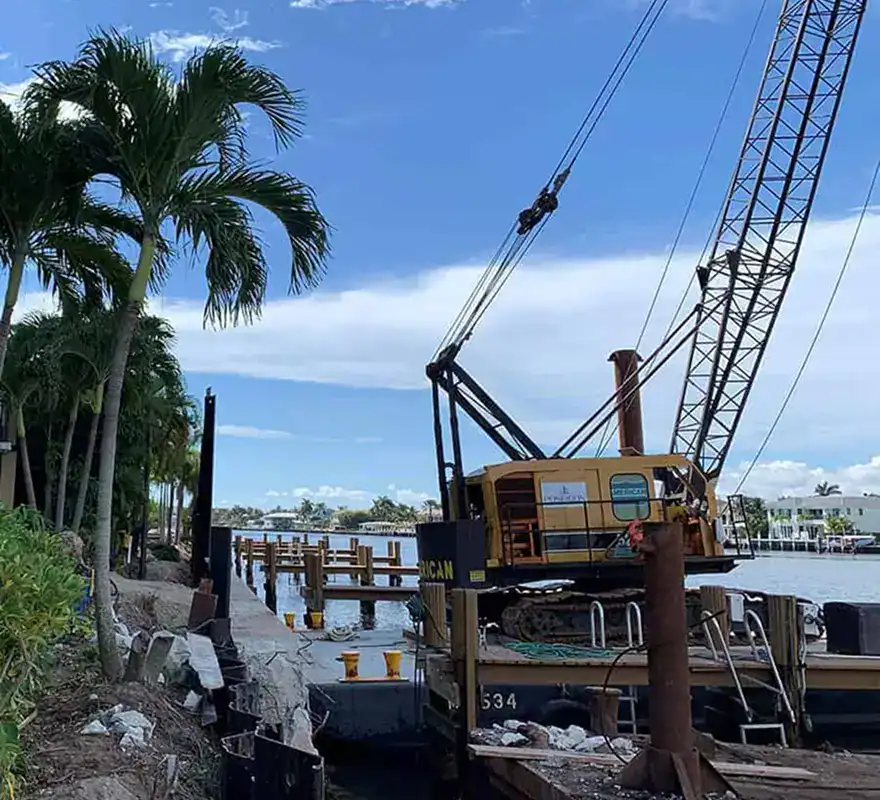
Much of Florida’s construction happens at the water’s edge. Our marine construction vibration monitoring covers pile driving for docks and wharves, sheet piling for seawalls and cofferdams, beach renourishment, and in-water demolition. We place seismographs and sound sensors on piers, seawalls, and shoreline structures, and we offer airborne and underwater noise monitoring when permits require it.

Vibration monitoring station at a Florida seawall sheet pile installation

Our Approach to Construction Vibration Monitoring in Florida

Seismic Surveys has monitored ground vibration and sound since 2001. Our engineers and geologists work with your team to develop a monitoring program for your contract documents, equipment, and nearby structures.

  • Before work starts: pre-construction condition surveys and baseline readings at the structures in your monitoring zone.
  • During construction: vibration monitoring with remote seismograph stations that send data over cellular networks, plus structure movement monitoring where settlement is a concern.
  • Data you can access: our NOW Access platform posts data online after each event and sends alerts via email or text, helping your team meet FDOT’s 24-hour reporting window.
  • If a claim comes in: documented records, claim support, and expert testimony to answer it.

The same approach supports our civil construction work across the country.

Florida Projects

  • FDOT Sheridan Street Bridge
  • 400 Central Avenue Tower, St. Petersburg, FL
  • Indian Creek Seawall, Miami Beach, FL
  • Miami Beach Renourishment, Miami, FL
  • Broward Beach Renourishment, Broward County, FL
  • Ocean Inlet Park Marina Replacement, Palm Beach County, FL
  • Ocean Reef Club, Key Largo, FL
  • Big Fishweir Creek Aquatic Ecosystem Restoration, Duval County, FL

Vibration Monitoring Across Florida

Our Florida teams work from two offices, with projects from Duval County to Key Largo.

  • West Palm Beach Office: 2 Harvard Circle, Suite 450, West Palm Beach, FL 33409
  • Orlando Metro Office: 7085 University Boulevard, Winter Park, FL 32792
  • Phone: (888) 250-6566

FAQs: Florida Vibration Monitoring

Common questions about FDOT requirements and construction vibration monitoring in Florida.

No. Under Section 108 of the FDOT Standard Specifications, vibration monitoring is required when the contract documents call for it, usually in the Summary of Monitor Existing Structures table in the roadway plans. Local permits or project specifications can also require it.

Section 108 sets an action threshold of 0.5 inches per second. If vibration reaches that level or damage is observed, the contractor stops the vibration source, notifies the Engineer, and submits a corrective action plan.

FDOT ties the distance to hammer energy. Structures within 0.25 times the square root of the hammer energy (ft-lb) get pre- and post-construction surveys, and structures within 0.5 times that value get settlement monitoring. A 40,000 ft-lb hammer gives about 50 and 100 feet.

Section 108 requires that vibration records be submitted to the Engineer within 24 hours of the monitoring activity. Remote seismographs and online data access make that timeline practical for long projects.

Yes. We have a West Palm Beach office at 2 Harvard Circle, Suite 450, and an Orlando metro office at 7085 University Boulevard in Winter Park. Both can be reached at (888) 250-6566.

Yes. We monitor vibration and noise on marine construction, including pile driving for docks, sheet piling for seawalls, and beach renourishment. Projects include the Indian Creek Seawall in Miami Beach and the Broward Beach Renourishment.

Who We Serve

We provide geotechnical and structure movement monitoring services for:

Civil Construction

Vibration and noise monitoring for civil construction projects to document effects transmitted to nearby structures.

Sensitive Structures

Vibration and noise monitoring for demolition, construction, and renovations in and around vibration-sensitive structures.

Marine Construction

Vibration and noise monitoring to document effects of marine construction on third-party structures, people, and marine life.

Transportation

Traffic vibration monitoring to assess the structural health of bridges and roadways and identify structural changes.

Mining

Vibration and overpressure monitoring for mining to document compliance and protect nearby structures.

Demolition

Vibration and Noise Monitoring capturing and documenting the effects of vibrations generated during demolition processes.

Visit our applications page to learn more about how clients use our services.

Request Vibration Monitoring for Your Florida Project

Whether your project is still in planning or piles are already going in, Seismic Surveys has the experience and equipment to keep your work within limits and your records complete. Contact us to set your Florida project on a safe and successful path.